
The Educational Sector Post Crises: Challenges and Prospects
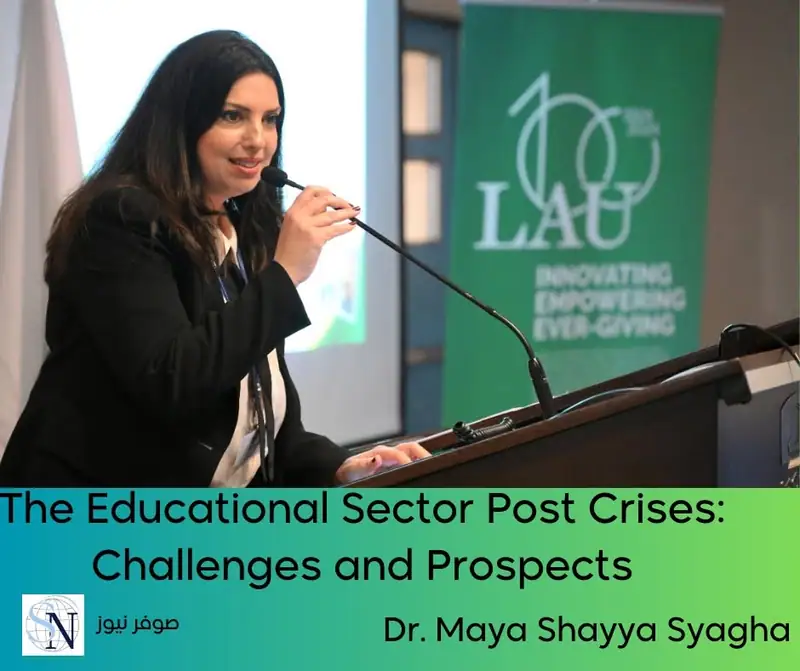
An overview of the most prominent challenges that the educational sector, especially the university sector, faced and continues to face after the war, with Dr. Maya Shayya Syagha- Professor at the Lebanese American University LAU and the Lebanese University.
One of the biggest challenges wars and crises, especially economic ones, have had on societies are the educational challenges . It rather extends to include psychological, human and non-human resources, which negatively affects the quality of university education. Wars have devastating effects on all sectors of life, especially the educational sector, which is the cornerstone for the development of any society. University education, which should be an incubator for science, knowledge and innovation and is expected to enable learners to face the expected and unanticipated challenges, is exposed to serious threats that affect its quality and methods of delivery, as well as its sustainability.
Destruction of the infrastructure of educational institutions
One of the biggest challenges facing post-war higher education is the destruction of educational infrastructure. In many countries that have experienced devastating wars, universities and educational centers have been severely damaged, hindering students’ ability to access education. In some cases , universities may stop offering their usual programs, thus hindering the dynamism of the educational process.
Deterioration of financial resources
After war, governments often suffer from severe economic crisis. This directly affects funding of universities and educational centers. For example, many universities may have to reduce their budgets for scientific research, reduce the number of scholarships, or even reduce the number of faculties and departments that enrich the dynamics of learning and teaching.
Psychological and social challenges for students
I can confirm from my teaching experience that this aspect of the challenges has a profound and, unfortunately, long-term impact. Regardless of the innate ability of humans to adapt and adjust to various surrounding circumstances, the psychological impact is not like material loss, for example. When we provide financial support to any educational or non-educational institution, we can say that the “material losses” have been compensated! We cannot apply this to psychological effects that cannot be restored with such simplicity! For example, it is not easy to treat post- war disorders, trauma, anxiety depression, etc. as quickly as we would like! Hence, universities, especially the Lebanese University have to be promptly involved and must provide a supportive educational environment that meets the psycho-social needs of students, through counseling services and academic advising, among others.. Universities like LAU and other leading universities have established supportive centers that tackle psychological and social challenges that continue to influence students’ academic achievement, and their effective participation in university activities as well as their engagement in the labor market.
Reliance on digital and virtual learning
Post-war education requires not only rebuilding the infrastructure of educational institutions, but also innovative strategies to restore confidence and the ability to achieve academic achievement. Universities must keep pace with these challenges by improving educational programs and utilizing modern technology to improve the educational process.
Artificial Intelligence: Friend or Foe?
As for artificial intelligence, which has become a de facto title, how can educational institutions reap the benefits and not more useless discussions accompanied by anxiety and fear of this “new challenger” or “new normal” with which we must come to terms in the future? Since man is the enemy of what he does not know, educational institutions must realize the importance of constructive engagement in the dynamics of artificial intelligence within a legal and regulatory framework that those concerned must establish at the state and institutional levels.
This was a reading of some of the challenges and some aspects of the desired solutions that we can expand the discussion about later, placing this in the hands of the future government in general and the Ministry of Education in particular as well as in the hands of a ministry whose title, for the first time in Lebanon, is “Technology and Artificial Intelligence Affairs,” which we hope will become a sovereign ministry for artificial intelligence, digital governance, and innovation.
Dr. Maya Shayya Syagha
Professor at the Lebanese American University (LAU)
School of Business/Management/Masters Program in Human Resources Management (MSHRM)/Soft Skills Coordinator
Professor of Human Resources Management and Marketing Strategy at the Lebanese University