
Lebanon Between Two Weapons: Is History Repeating Itself?
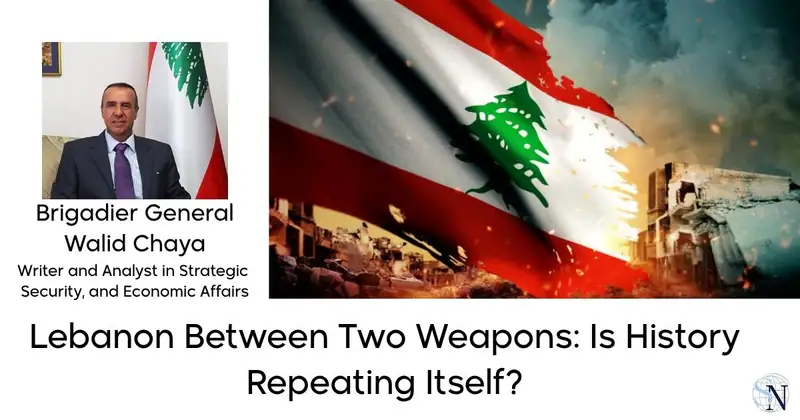
By Brigadier General Walid Chaya
When President Suleiman Frangieh refused to deploy the Lebanese Army at the outset of the civil war in 1975, he understood that involving the military in an internal conflict would threaten its unity—and perhaps its very existence. Yet despite his caution, he could not prevent the war from erupting.
Today, nearly half a century later, that same concern resurfaces—though in different forms. The scene repeats itself, albeit with new tools and names. Weapons outside the authority of the state remain the central issue. The difference now is that the threat no longer comes from a single source, but from multiple actors, both domestic and foreign.
Hezbollah’s weapons are prominently present. The group is a political party, a parliamentary bloc, and a government component—but it also maintains an arsenal that is not under the control of the Lebanese state, and it is aligned with regional axes that extend beyond Lebanon’s borders. This weaponry has long been a point of controversy, especially since its intervention in the Syrian war—a move that was widely rejected for dragging Lebanon into a dangerous external conflict.
But the threat is no longer confined to one side.
The recent involvement of Lebanese militants from the North in fighting in Syria’s Suwayda province evokes the same rejected principle: Lebanon must not become a platform, passageway, or participant in the wars of others. Just as we opposed young men from Dahieh heading to fight in Syria, we reject today the participation of young men from Tripoli, Akkar, or any other area for the same purpose. The principle is the same, and the violation is unacceptable—regardless of the actor.
The problem is deeper than a single weapon.
It is a crisis of governance, a vacuum in sovereign decision-making, the erosion of institutions, and a submission to an imbalanced power dynamic. The state observes, adapts—but does not govern. Weapons outside the legitimacy of the state now come in many forms, under many flags—all eating away at the concept of the state from within.
History does not repeat itself word for word—but it does repeat its lessons.
In the 1970s, Lebanese people believed the war was far off—until it erupted. Today, some think coexisting with chaos and uncontrolled weapons can go on indefinitely. But reality suggests otherwise. What we should fear now is not the surprise of an explosion—but the silent collapse already underway.
Unless the Lebanese collectively agree that only the state can hold weapons, we are not building a nation—we are merely postponing its fall.
And time is not on anyone’s side.